Opinion
The future of HR and AI
AI will reshape recruiting, but like driver assistance in its early years, it still needs a human at the wheel.
Arsénio Ferraz — CEO & Co-Founder, Venora · 4 July 2026 · 6 min read
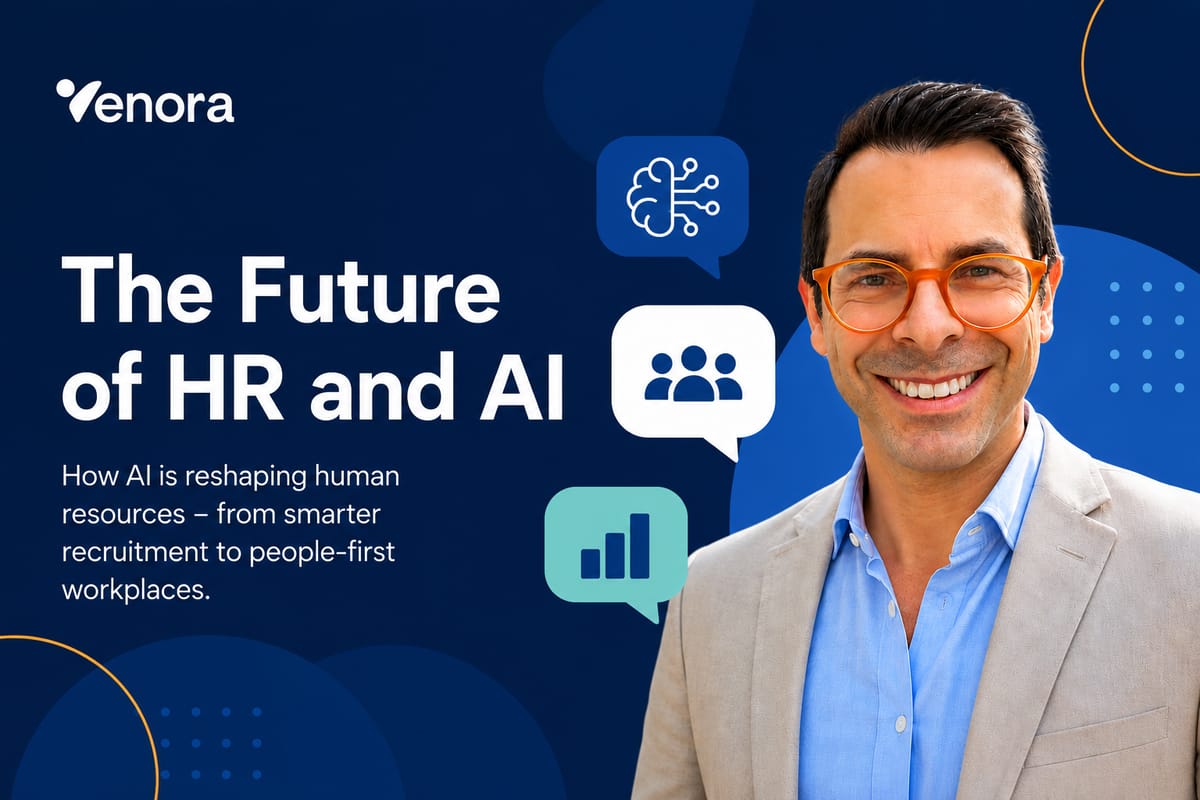
I have spent more than twenty years watching technology arrive in places people swore it never would. Payroll, accounting, customer service, logistics. Each time the pattern repeats. First disbelief, then a rush, then the slow and honest work of deciding what the machine should really do and what has to stay with us. Recruitment is living that moment right now, and I want to be clear about where I stand.
HR is having its inflection point
For decades, hiring has been stubbornly manual. A recruiter opens an inbox with three hundred CVs for a single role and starts reading, one document at a time, late into the evening. By CV number ninety, attention drifts. Strong candidates slip through, not because anyone is careless, but because human attention is finite and the volume is inhuman. This is exactly the kind of problem AI was built to help with.
Modern models can read every CV against the real requirements of a role, in minutes, without getting tired at number ninety. They can surface the candidate the recruiter would have missed, explain why someone fits, and turn hours of screening into minutes of review. That is not science fiction. At Venora, it is what we ship today.
The driver-assistance analogy
Here is the part I care about most, and the reason I keep reaching for a comparison from a very different industry: driving.
When advanced driver assistance first appeared, it did not replace the driver. It watched the lane, kept a safe distance, braked when you were distracted, and warned you about the car in your blind spot. It made good drivers safer and long journeys easier. What it did not do, what it still does not do responsibly, is take full ownership of the decision. Your hands stay on the wheel. Your eyes stay on the road. When something matters, you decide.
AI in recruitment is at exactly that stage. It is assistance of the highest quality: it sees more than you can, it never tires, it flags what you might miss. But it is not the one who should sign the offer. Hiring decisions change people’s lives, and they carry context a model simply cannot see: the team that needs a certain kind of energy, the candidate whose unusual path is precisely their strength, the judgement earned over a hundred interviews.
Why human validation is not optional today
There are three reasons I insist on human validation, and none of them are nostalgia.
- Fairness. Models learn from data, and data carries the bias of the world that produced it. A human in the loop is how you catch the moment the machine quietly penalises the wrong thing.
- Accountability. When you advance or reject a candidate, someone has to be able to stand behind that choice and explain it. A black box cannot be held accountable; a person can.
- The law increasingly agrees with me. Under the EU AI Act, recruitment is a high-risk use of AI, and meaningful human oversight is not a nice-to-have; it is a requirement.
We did not bolt human oversight on to satisfy regulators. It has been the core of our product from day one.
The goal was never to remove the recruiter from the room. It was to give the recruiter a room that scales.
What AI should own, and what it should not
I am not arguing for caution as an excuse to do less. The opposite. AI should aggressively own the parts of hiring that exhaust people and add no human value: reading every CV, matching against requirements, ranking, comparing, drafting, scheduling, remembering. Give all of that to the machine, and give it gladly.
What stays with us is judgement. The final call. The conversation. The decision to take a chance on someone. The machine proposes; the human disposes. When AI does the reading and the recruiter does the deciding, both are doing what they are best at, and the candidate gets a fairer, faster, more human process than either could deliver alone.
Where this goes next
Will the balance shift over time? Of course. Driver assistance did not stand still, and neither will we. As these systems earn trust, through transparency, through being right in ways you can verify, through years of people checking their work, they will be handed more. That is how trust is supposed to work: earned in increments, not demanded up front.
But I do not believe the destination is a fully autonomous hiring machine that decides who works where while people watch from the sidelines. I am not even sure that world would be a better one. The future I am building toward is quieter and, I think, better: every recruiter with a tireless, transparent copilot that does the heavy lifting and always, always, leaves the final word to a person.
That is the future of HR and AI as I see it. Not replacement. Assistance, with a human at the wheel.